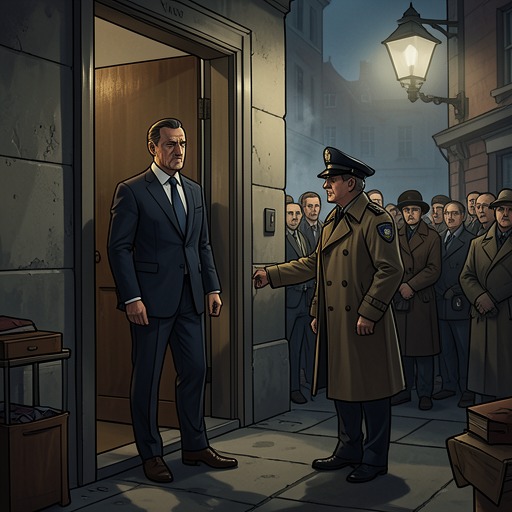
Hauck Exman disappears
The AxHauck Exman disappears after Detective Burton’s visit leaves him apparently spooked, turning a tentative line of murder investigation into an unexplained flight. The episode is reported to Burke Devore by Burton, but its most consequential tension lies in the gap between Burton’s uncertainty and Burke’s private recognition: while denying that Exman means anything to him, Burke thinks of him as a fabricated identity whose supposed sea voyage accounts for his absence.
The Investigation Before the Disappearance
Burton introduces Exman to Burke by taking a color photograph from his notebook. It is a formal portrait, showing Exman in a tuxedo and giving him, in Burke’s estimation, the appearance of a bodyguard. The image makes an otherwise absent man briefly present in the conversation, while Burton’s questions test whether Burke recognizes him. Burke answers that the name does not ring a bell and asks who the man is.
Burton’s interest in Exman comes from a possible connection among representatives of companies competing for a contract in D.C. Everly, Asche, and Exman were all there at the same time. Burton acknowledges that the police have not proved the three men met, and does not claim that they did; he says he does not think proof of a meeting is necessary to pursue the inquiry. The simultaneous presence offers a possible point of connection, not a completed explanation of the murders.
Burton had spoken to Exman a couple of weeks earlier, in the same manner that he had spoken to Burke. He says he disliked Exman’s behavior, but also makes clear that the interview produced no evidence on which to arrest him. The distinction matters: Exman’s disappearance follows police attention, yet Burton’s account does not establish that the detective had uncovered proof against him. Suspicion and evidence remain separate even as the timing invites a connection between them.
The Flight and Its Traces
Burton tells Burke that his visit seems to have spooked Exman. Exman left without telling anyone, and his car remained in the parking lot where he worked. Burton describes him as having disappeared completely. The abandoned vehicle and silent departure are the concrete signs of the flight: there is no reported farewell, explanation, or confirmed destination.
The search of Exman’s house adds another troubling detail. Police find roughly a dozen weapons of different kinds and test them against the bullets they have recovered. Burton says investigators feel Exman probably disposed of the gun used in the killings, but this is presented as an assessment, not a discovery. The firearms intensify the suspicion surrounding him while leaving the crucial forensic question unresolved: the weapon believed to have been used is not among the guns reported as found.
Exman’s departure also becomes difficult to explain through an ordinary journey. Burton says Exman did not take his passport, though he allows that he might have had another one. Singapore is the place he seemed to talk about most, according to Burton’s conversations with Exman’s two girlfriends. Burton raises it as a possible destination rather than a confirmed location; at the time of their conversation, the police still expect they may track Exman down eventually.
Domestic Circumstances and Uncertainty
The investigation into Exman’s life turns up serious conflict at home. His wife had already consulted a lawyer about a divorce after catching him having an affair. She was his fourth wife, and Burton says Exman had been playing around. These details give the disappearance a personal context, but do not establish that domestic trouble caused him to leave. Burton’s account places marital discord beside the police inquiry without resolving how much either contributed to the flight.
Burton describes Exman as making trouble in his own life and in other people’s lives. His remark follows the news of the affair and divorce, then gives way to the search of the house and the inventory of guns. The sequence enlarges the portrait of a man entangled in several kinds of trouble, but the police still cannot say where he has gone, whether he is carrying another passport, or whether any weapon in the house matches the bullets.
Burke’s Recognition and the Scene’s Irony
Burke’s outward response is composed: he says he cannot imagine Exman suddenly leaving his life, asks whether he had a family, and tells Burton that he has not been much help. His private thoughts tell a different story. Before denying recognition, he identifies Exman as the Marine from one of his résumés, supposedly away on a sea voyage, and thinks that Burton could have talked sailing with him. The discrepancy makes Burke’s denial more than a simple failure to remember; he knows the identity Burton is asking him to assess, while concealing that knowledge in the conversation.
When Burton says he has another name and photograph to try on him, Burke immediately wonders which of his résumés it will be. That thought links Exman’s disappearance to a wider pattern of assumed identities without explaining, in this encounter, how Exman became part of that pattern. The exchange also turns the photograph into a test of Burke’s performance: Burton offers a face and a name, and Burke answers as though they are unfamiliar.
The episode closes without resolving Exman’s whereabouts or the police’s suspicions. Burton has no evidence to arrest him, the possible meeting among the three company representatives remains unproved, and the suspected murder weapon has not been identified among the guns found at home. Against those uncertainties, Burke’s silent recognition stands out as the scene’s sharpest disclosure: the detective sees a missing suspect, while Burke recognizes a persona he has already assigned to the man.